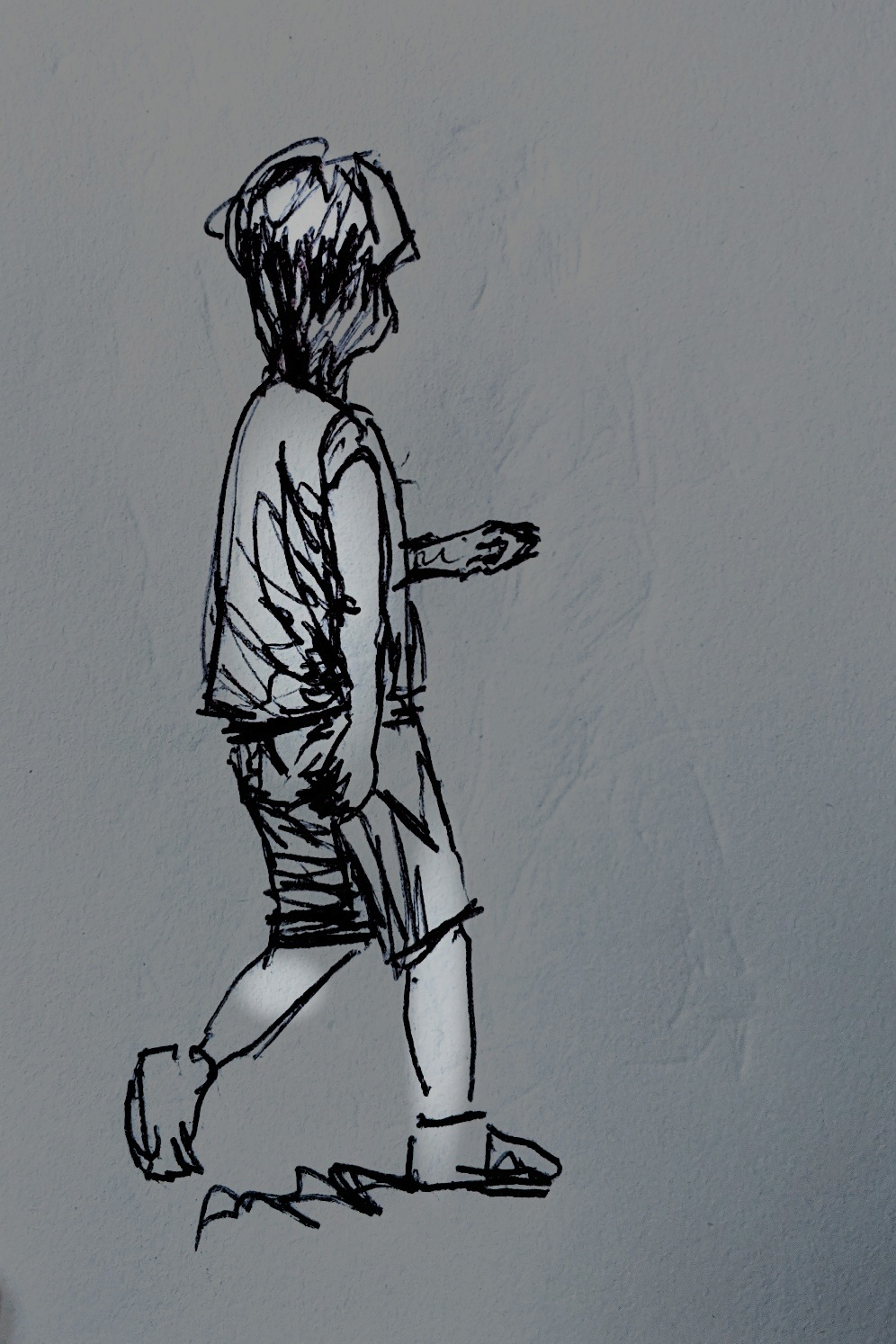
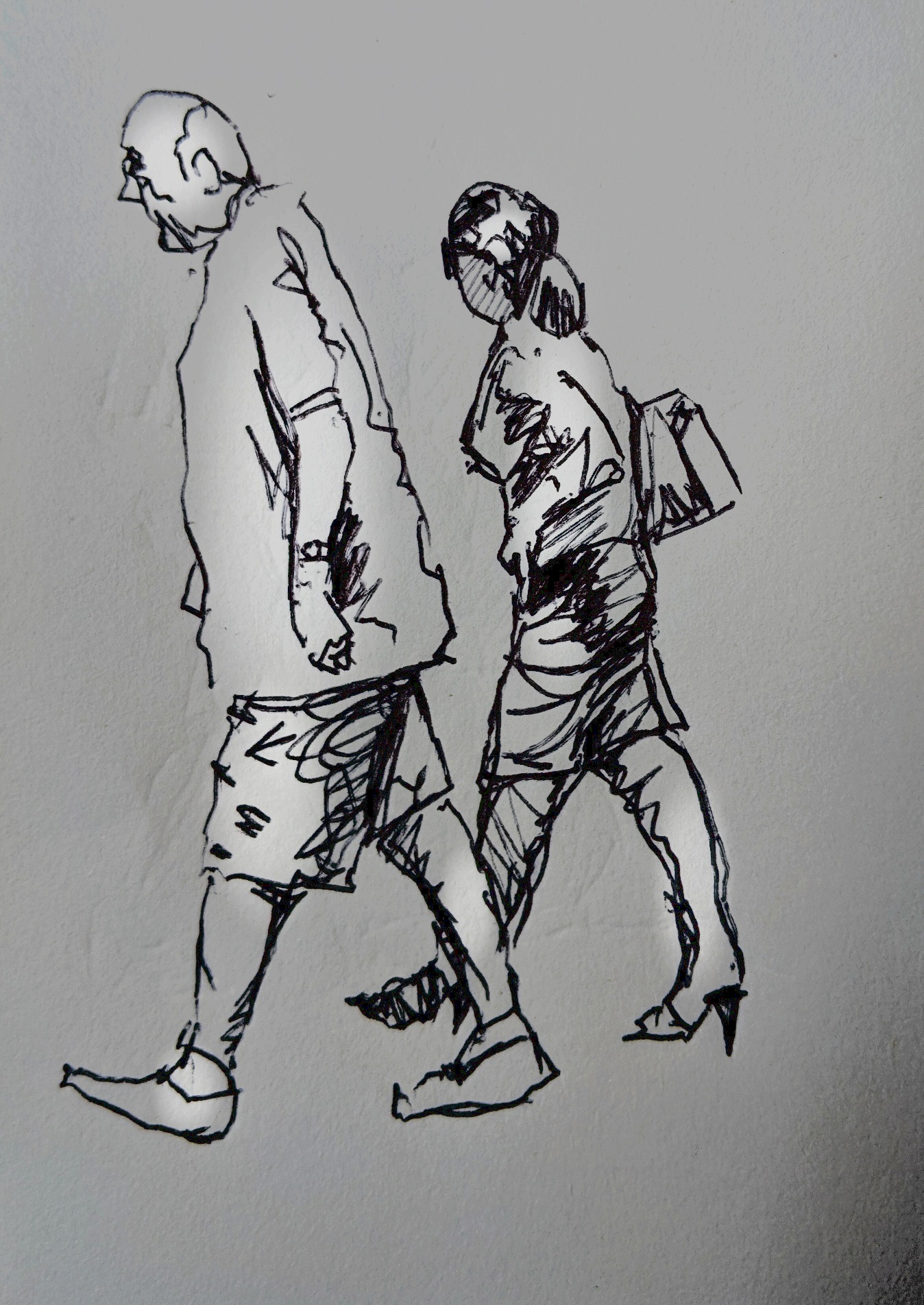
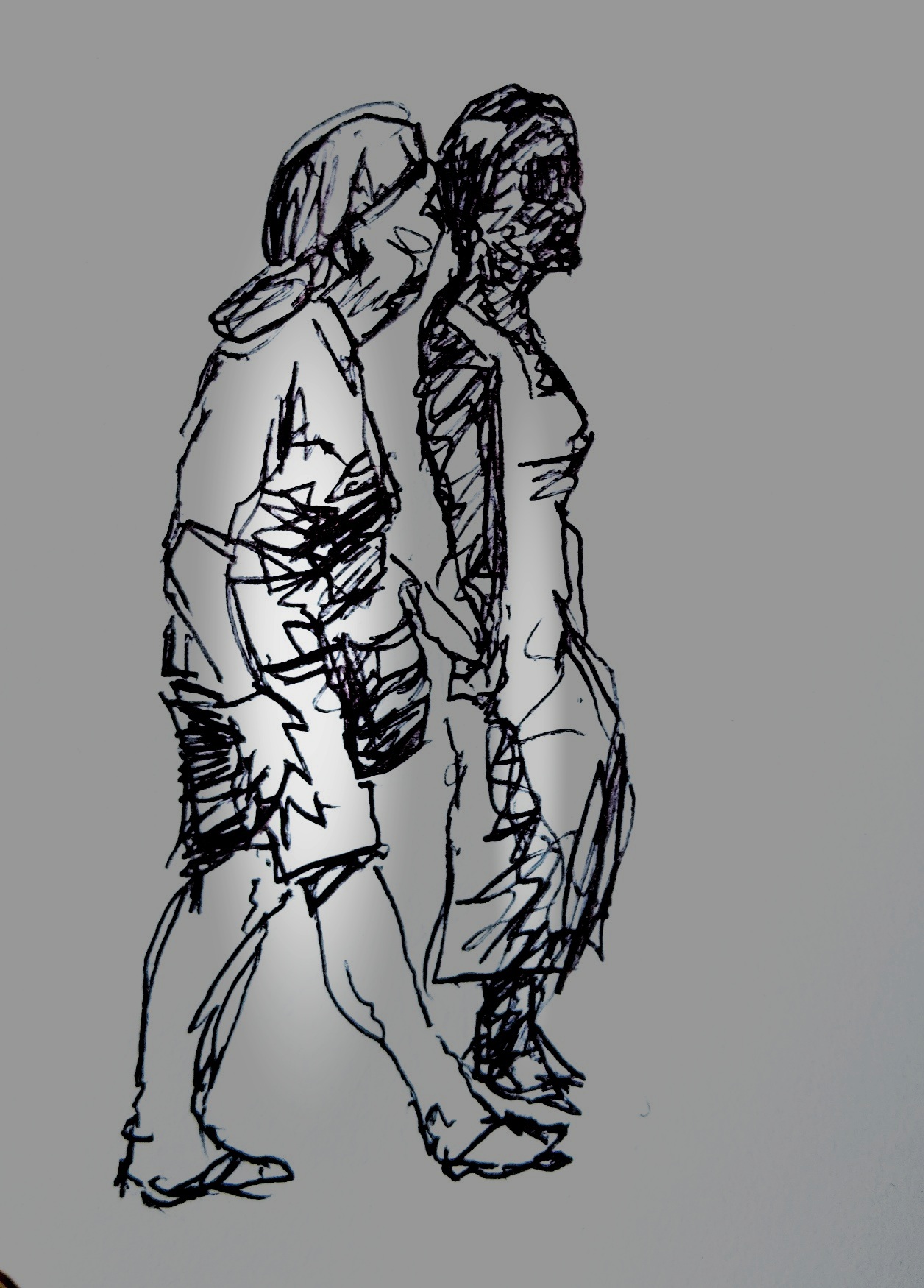
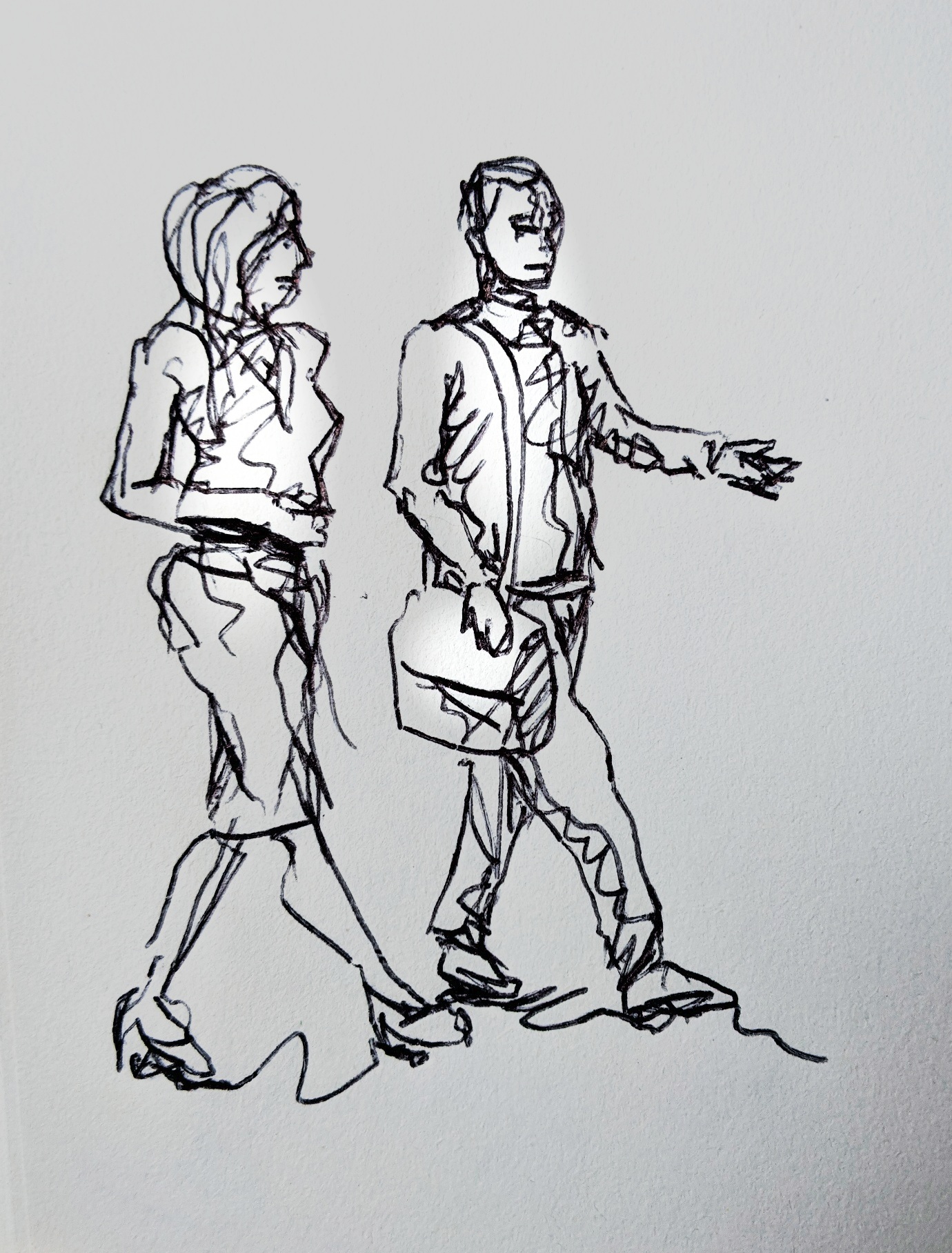
Here are a few sketches I did recently with a vague theme of things starting to get back to normal as lockdown in England gradually ends. Hopefully soon we’ll all have somewhere to go again.
How experiencing a traumatic life event can feel like you’re watching it on TV (even if you’re Andy Warhol)
Did you ever go through something traumatic in your life and get the sensation that everything slowed down and you were watching it happen on TV or in a film? The correct term for this is ‘dissociation’ and many people experience it. It may feel like you’re disconnected from yourself and the world around you, detached from your body or as if you’re watching yourself in a film. Dissociation is a way the mind can cope with too much stress such as during a traumatic event.
Legendary artist Andy Warhol once experienced this and it inspired him to produce the picture of a gun above. I once saw this Andy Warhol picture at Tate Liverpool but didn’t realise that the gun depicted is very similar to the one used, on June 3 1968, to shoot him. On June 3, 1968, radical feminist writer Valerie Solanas shot Warhol at his studio.
The woman who shot him was Valerie Solanas who had been a known figure on the scene having written the S.C.U.M. Manifesto, a feminist tract that advocated the elimination of men (sounds like good, frothy, holiday reading). At 2:00 pm that day she apparently went up into his studio looking for Warhol. She rode the lift up and down until Warhol finally appeared. They entered the studio together. The phone rang; Warhol answered. While he was on the phone, Solanas fired at him three times. She missed twice, but the third shot went through both lungs, spleen, stomach, liver, and oesophagus. She then shot art critic Mario Amaya in the hip. She tried to shoot Fred Hughes, Warhol’s manager, in the head but her gun jammed. Hughes asked her to leave, which she did. Warhol was taken to hospital where he underwent a five-hour operation.
Amaya received only minor injuries but Warhol was seriously wounded and barely survived. Surgeons opened his chest and massaged his heart to help stimulate its movement. He suffered physical effects for the rest of his life, including being required to wear a surgical corset. The shooting had a major effect on Warhol’s life and art and lead to death being a theme for much of his subsequent work.
Above, Warhol shows the wounds caused by the shooting. The actual moment-by-moment experience of being shot must also have been a life-changing, work-changing experience. The shooting was very real but to him felt unreal. I’ve had moments in my life where certain things (usually events which are shocking or upsetting in some way) happen and it’s like time slows down; the whole thing’s like a dream. Like when you’re in a car accident or you stupidly break your leg falling off a skateboard and you feel like you’re watching it happen in a film. Real things can feel unreal (as with the shooting) and unreal things can feel real (as with images of iconic celebrities).
“Before I was shot, I always thought that I was more half-there than all-there—I always suspected that I was watching TV instead of living life. People sometimes say that the way things happen in movies is unreal, but actually it’s the way things happen in life that’s unreal. The movies make emotions look so strong and real, whereas when things really do happen to you, it’s like watching television—you don’t feel anything. Right when I was being shot and ever since, I knew that I was watching television. The channels switch, but it’s all television.“
I can’t take many photographs at the moment because I still can’t walk very well after leg surgery. I can hobble around the house on crutches but I’m not confident enough to go outside on them. Except for trips to hospital, I haven’t been out since January 10. Fortunately, no-one else has been able to go out either due to a certain pandemic so I’m not the only one going stir crazy. Any photos I have managed to take have contained a common item; crutches. I have a feeling that every photo I take for the rest of my life will have a pair of crutches in it somewhere. Leaning on the wall, sticking out from under the sofa, poking through a doorway… these things will probably photobomb all photos taken by me from now on. Not sure exactly how I feel about them. They enable me to get around a bit so that’s good. But they’re hard work. They wear me out and they dig in me sometimes and hurt. They fall over every ten seconds and they often lean just out of reach, taunting me. They’re hard and spindly and they’re not quite the right height. I think they might be smirking at me. But I need them so that’s that. I don’t think they need me. Bastards.
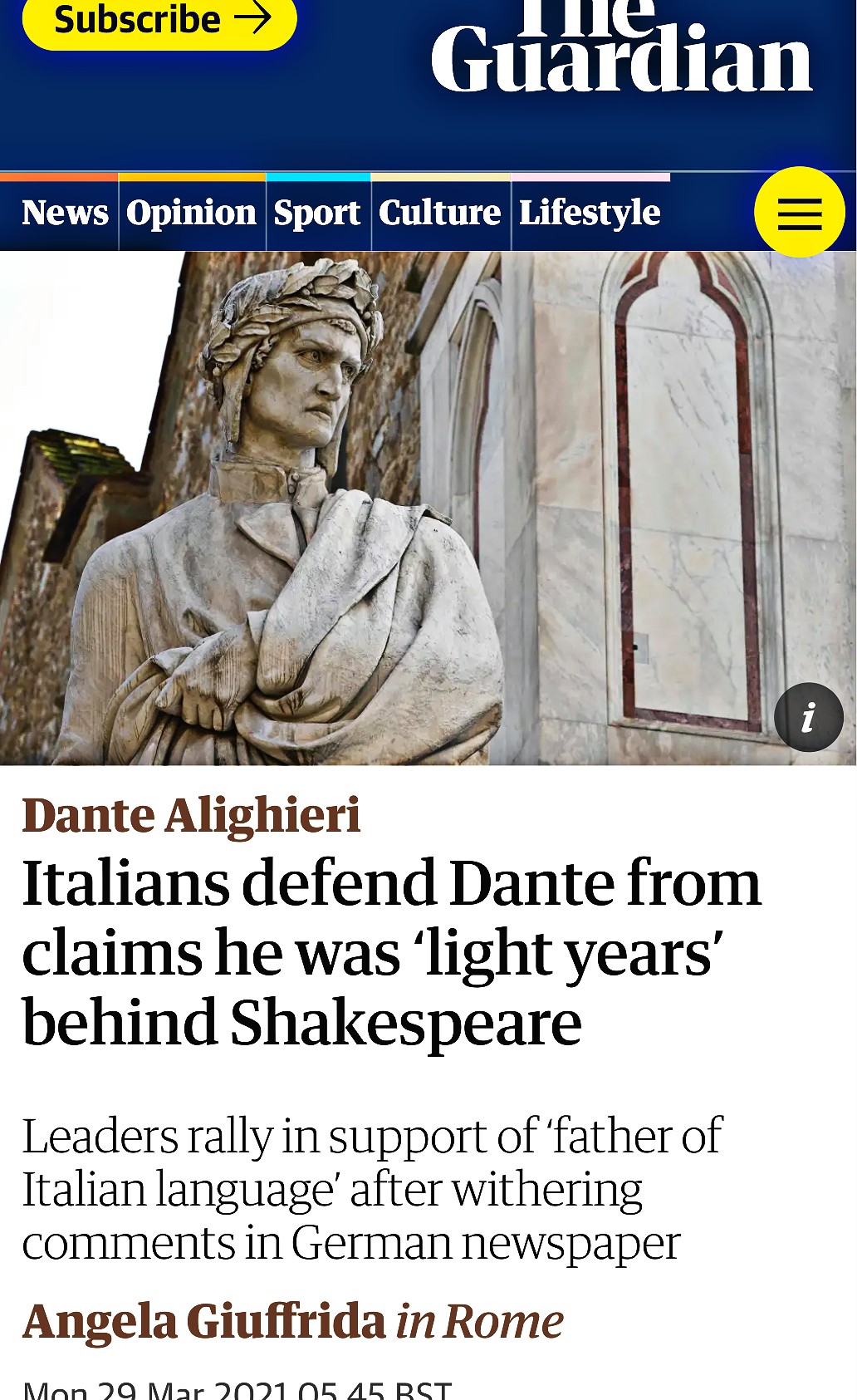
O’Sullivan lost his battle against Robertson in the final of the Snooker Tour Championship but over on the other table two other old titans were fighting it out; Shakespeare and Dante. As Angela Guiffrida reported in The Guardian, Italian political and cultural leaders had been slugging it out on behalf of legendary 12th Century poet Dante Alighieri after a German newspaper challenged his importance to the Italian language and claimed that William Shakespeare was “light years more modern”.
Harsh criticism of the comments by journalist Arno Widmann came from his own team. Eike Schmidt, a German art historian and the director of Florence’s Uffizi Gallery described him as “ignorant” during a radio interview. But a fierce fightback also came from Italian heavy hitters such as Pope Francis and the Italian president, Sergio Mattarella who made intelligent and spirited points in favour of their player, I mean poet.
To me these kinds of exchanges completely miss the point of not just the art of Shakespeare and Dante (sounds like an ITV Sunday night detective series) but of all art. Everything isn’t always a competition. That’s what distinguishes art from sport, surely; its value doesn’t chiefly come from comparison. In snooker, we know a player is good because they beat another player. We don’t regard a painting or a novel or a sculpture as good because it beats another one. There’s not even a clear way to keep score although many try to figure one out.
There are such things as art competitions of course, in fact these are currently more popular than ever. I quite like watching Portrait Artist of The Year, Landscape Artist of The Year and even the rowdy newcomer on Channel 4 at the moment, Drawers Off. But these aren’t true competitions like the one Ronnie O’Sullivan and Neil Robertson battled in last Sunday. An artist might win a painting competition but they haven’t done it for doing anything as clear cut as potting balls. The artist might have been judged the winner because one of the judges felt they captured the emotion of the subject or because they showed great perception or originality or a billion other reasons. The nearest you can get to distilling it down to the equivalent of potting a snooker ball is probably to say that you score a point in art when you manage to ‘affect’ someone. And no-one really knows how you do that. One thing is certain, though; it’s harder than screwing back off the cushion to get in line for the pink.
That’s why the argument covered in the Guardian article feels so ridiculous and futile; it reduces complex stuff to ludicrously simple points of comparison. As Angela Guiffrida reported, the best response is probably to do what Italian culture minister, Dario Franceschini, did. By tweeting a verse from Dante’s Inferno, he let the art speak for itself. “Non ragioniam di lor, ma guarda e passa (Inf. III, 51)” which means “let us not reflect upon them, but watch and move on”. Or we could just watch the snooker.
On Sunday 10 January I had an accident and broke my leg. It was my own fault; I was messing about on a skateboard, as though I’m not way too old for that. I was only on the thing for about a second before doing a spectacular back flip and landing (really awkwardly) on the ground. I knew I’d done something serious because my left foot was pointing in a direction I’ve never seen it point in before. And there was the pain. I’ve never experienced anything like it. I couldn’t move an inch. An ambulance was called but, for whatever reason, it never arrived. I lay there on a concrete path with trees all around for two and a half hours by which time it had gone dark.
A father and son, John and Vincent were walking by and asked if they could do anything to help. It turned out that they had an unused wheelchair at home and they offered to go and fetch it so they could ferry me to their car and then on to hospital. I’ve never felt so thankful to anyone. It would have been so easy for them to keep walking and not get involved. I’m sure they had stuff in their lives that they needed to attend to rather than be bothered scooping up some writhing stranger who probably should know better than to go anywhere near a skateboard. But they were bothered. They came back with the wheelchair and did what must have been incredibly unpleasant for them, they picked me up and eased me in. Up to that point, I had thought pain could not get much worse than what I was experiencing. When they picked me up though, it got ten times worse in a second. I’ll never forget seeing the horror on their faces as they got a first proper look at my leg and the damage I’d done to it. I had to be wheeled along the path, over a bridge and through a gate before I got to the car. I couldn’t possibly sit in either front or back seats so they opened the hatchback and I had to be hauled into the boot. Clutching at my leg, we set off for A & E. It took about twenty minutes and I think I was going in and out or reality a bit as songs on the radio seemed weirdly distant and surreal. I must have said thank you about a trillion times to John and Vincent as they dropped me off and I was bundled into the hospital.
They came to see me at home a few weeks later following surgery on my leg and I thanked them another few thousand times then. Apparently, I had snapped my tibia (the thick bone in my leg) and my fibula (the thin bone in my leg) in one easy move. I had to have a metal rod inserted from top to bottom with screws at either end. A hobby of mine is sketching and I often draw people as they pass by on the street. Those of us who are able-bodied take movement so much for granted; strolling through the park, hurrying to work, scurrying round the shops… I took it for granted when I stepped on that skateboard. We should take John and Vincent as examples. If we are blessed with the ability to walk, don’t use it to walk away.




 Jon Kenna .com